Newsletter available here
Timebanking UK: The True Power of Timebanking – Connection, Wellbeing and Community
The latest update from Timebanking UK is here, bringing inspiring stories, encouraging figures and powerful reminders of what can happen when people come together and give their time.
With more than 6.8 million hours of mutual support exchanged across the country, timebanking continues to demonstrate that an hour can be worth far more than its monetary value. From reducing loneliness and improving mental wellbeing to helping people through some of the most difficult moments of their lives, these exchanges are creating stronger and more connected communities across the UK.
Where everyone’s time is valued
At the heart of timebanking is one beautifully simple principle: one hour given = one hour received.
For every hour someone spends helping another person or organisation, they earn a one-hour time credit which can then be exchanged for an hour of help themselves.
It creates an “economy of favours” where everyone’s time is valued equally, regardless of age, ability, background or the particular skill they have to offer.
That could mean helping somebody with their garden, providing DIY or IT support, cooking, dog walking, sharing a creative skill or simply spending an hour talking with someone who needs company.
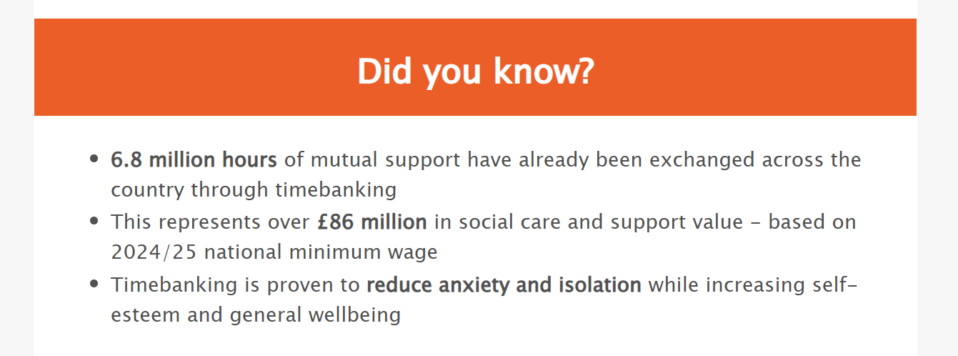
Together, these everyday exchanges are making a significant impact. More than 6.8 million hours of mutual support have now been exchanged through timebanking across the country, representing over £86 million in social care and support value, based on the 2024/25 National Minimum Wage.
But the real value goes much further than numbers.
How timebanking supports mental wellbeing
Loneliness and isolation can affect anyone, and sometimes what makes the greatest difference isn’t a formal service but simply knowing that somebody is there.
Timebanking creates opportunities for people to connect naturally, contribute to their community and recognise the value of their own skills.
Members across the network describe how being involved has helped them rediscover a sense of purpose and belonging:
“It’s great to feel needed. I never thought my skills would be useful in this way.”
“I get a lot out of it. It helps me, giving me a bit of structure… having a purpose.”
“When I can help someone out of a tough situation, it not only helps them but uplifts me as well.”
“Time banking has made it possible for me to reconnect with my community and find joy in simple acts of kindness.”
The benefits can take many forms. Timebanking can help build self-esteem and purpose, create natural friendships between neighbours and provide the everyday companionship and practical assistance that formal services cannot always offer.
It also provides a flexible and low-pressure way for people to become involved in their community. For some, that first small exchange can eventually become a pathway towards further volunteering, training or employment.
And importantly, there is no single definition of a “valuable” skill. From cooking and creative arts to IT support and dog walking, everybody has something they can contribute.
A community in action: the Somersham Time Bank story
Perhaps one of the clearest examples of the difference timebanking can make comes from Somersham Time Bank in Cambridgeshire.
One member joined the community after her husband was diagnosed with cancer shortly after they had moved to the area. With few local connections, she attended a carers’ meeting organised by the time bank.
What began as a meeting became an invaluable network of friendship, information and practical support throughout her husband’s chemotherapy.
When he later spent four months in hospital, Somersham Time Bank organisers Paula and Janet stayed in contact, connecting her with volunteers and organisations that could help with the many challenges she was facing.
Following her husband’s death, that community stepped forward again. Volunteers helped arrange flowers and prepare and serve drinks at his funeral, helping her give him the special send-off she wanted.
The support continued afterwards, with volunteers even offering to sit alongside her while she tackled the overwhelming administrative tasks that follow a bereavement.
As she explained:
“The kindness and compassion I have been shown by everyone at the Timebank has been absolutely amazing and is helping me through the blackest and most painful period of my life.”
Her experience also demonstrates the importance of reciprocity without pressure. There is no expectation that someone who receives support must immediately give something back.
Instead, when she feels ready, she hopes that volunteering her own time will help her regain a sense of purpose while allowing her to pass on some of the kindness she received.
“Being part of a community committed to helping one another is, without doubt, an enormous comfort and privilege.”
It is a powerful reminder that behind every time credit is a human connection.
2025: a year of growth
The latest national figures show just how far the timebanking movement now reaches.
During 2025, Timebanking UK recorded:
-
- 6,805,104 total hours exchanged
- 25,723 individual members
- 4,439 participating organisations
- 342,434 exchanges completed
- 165 active or developing time banks
Each number represents thousands of individual moments of support: people sharing skills, solving problems, meeting neighbours and helping one another.
And as the network continues to grow, so does the opportunity to bring timebanking to more communities across the country.
Pioneering neuro-inclusion in timebanking
Timebanking UK is also exploring how the model can become more inclusive and accessible.
In Redditch, Simon Preston is establishing a new time bank specifically for the neuro-divergent community.
Simon is a neuro-inclusion consultant and educator whose work focuses on removing structural barriers that can prevent neuro-divergent people from participating meaningfully in organisations and communities.
His approach considers recruitment, retention and communication as parts of one connected system.
For time banks, that can mean using plain, jargon-free language and visual information when recruiting members; creating predictable and structured onboarding; considering sensory and social needs when matching people; and giving members advance notice of changes while communicating in clear, literal language.
Perhaps most importantly, Simon advocates co-production: designing systems with neuro-divergent people rather than simply designing them for neuro-divergent people.
Simon led a Timebanking UK training session in April 2026, helping time banks consider practical ways to make participation more inclusive.
Looking beyond money: the “economy of favours”
The principles behind timebanking are also continuing to generate discussion internationally.
Timebanking UK’s Founding Advisor and former CEO Martin Simon recently published Time Money 2 in collaboration with partners in Spain.
The article explores the “economy of favours” and challenges the idea that financial exchange is the only way of creating wealth and value.
As Martin explains:
“Timebanking is a mechanism that encourages people to help one another in their homes and gardens, realizing that every person in society is an asset.”
It gets to the heart of what makes timebanking different. People are not simply recipients of services; everyone has knowledge, experience, skills or time that can be valuable to somebody else.
Want to start a time bank in your community?
Starting a time bank doesn’t mean doing everything yourself.
A good first step is to find two or three other people interested in helping you get things moving. You may be surprised by how many people in your neighbourhood or organisation want to become involved once the idea is introduced.
From there, Timebanking UK can provide practical support, including introductory materials, joining forms, handbooks and activities to help members identify and safely exchange their skills.
Timebanking UK members can also access the Time Online 2 platform, telephone and email support, national recognition and use of the TBUK logo, a step-by-step guide to establishing a time bank and the comprehensive 2026 training programme, covering areas including safeguarding, burnout prevention, demographic engagement and the future of timebanking.
Why timebanking matters
At its heart, timebanking is about something incredibly simple: people helping people.
It recognises that everyone has something to offer and that receiving help does not make someone less valuable to their community.
An hour spent making a phone call, tending a garden, explaining a smartphone, walking a dog or sitting beside somebody who is having a difficult day might seem small.
For the person receiving it, that hour can mean connection, confidence, independence, friendship or simply the reassurance that they do not have to face something alone.
And for the person giving it, the same hour can bring purpose, belonging and the knowledge that their contribution matters.
What happens next and how to get involved
-
- Find your local time bank and discover the exchanges taking place in your community.
- Offer a skill or an hour of your time. You don’t need specialist expertise; everyday skills and companionship can be just as valuable.
- Consider starting a time bank in your neighbourhood or organisation if there isn’t already one nearby.
- Join an Introduction to Timebanking session to learn how the model works and how to get started.
- Spread the word. The more people who participate, the more skills, connections and opportunities the network can offer.
Whether you give an hour, receive an hour or help create the connections that make an exchange possible, you become part of a movement that values what every person can contribute.
Because when everyone’s time is valued equally, every hour has the potential to make a difference.